Laser Hair Reduction in Delhi
“Done Right, with Alma Soprano Titanium Special Edition Finally“
Our Results
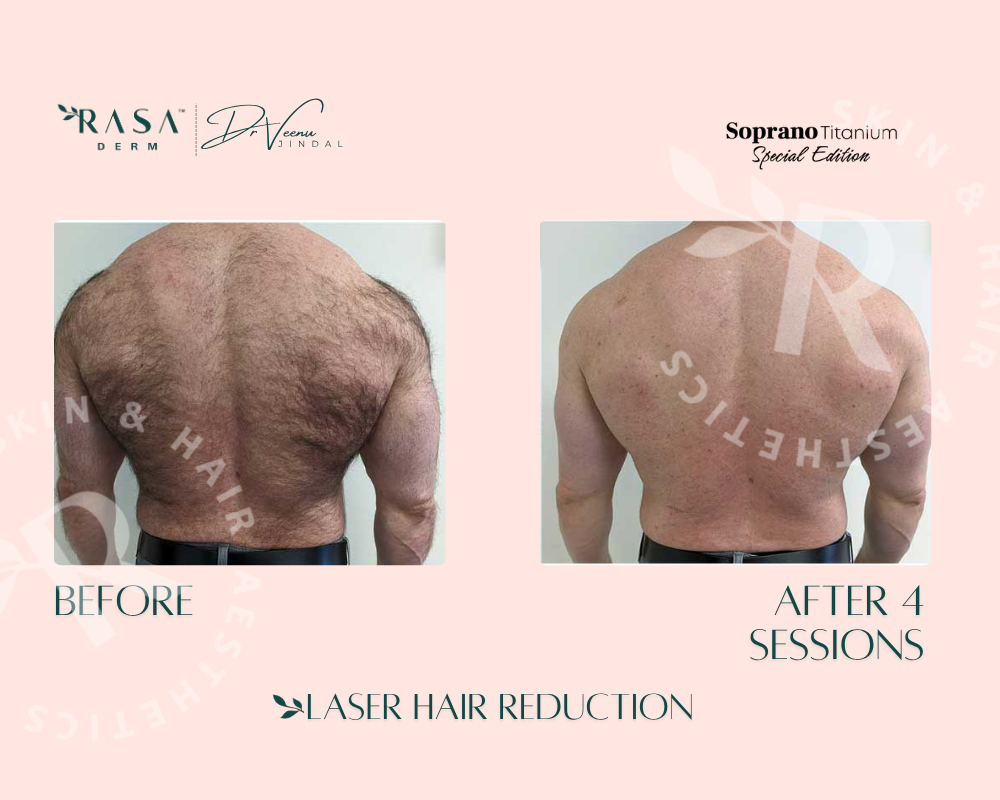
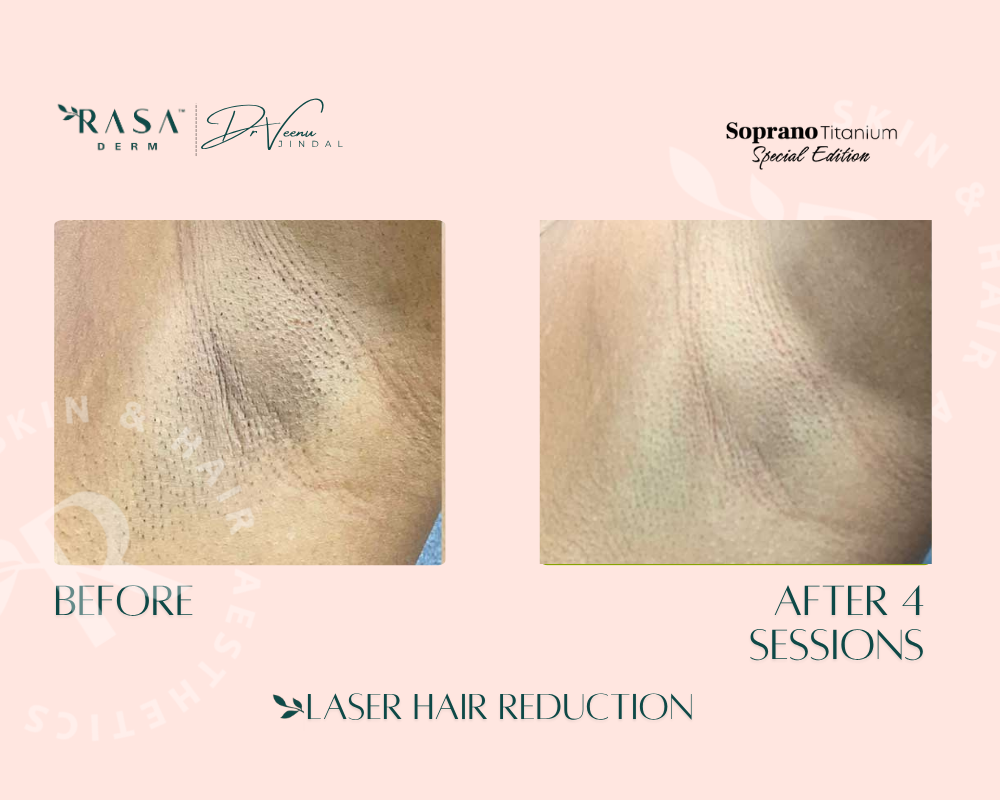
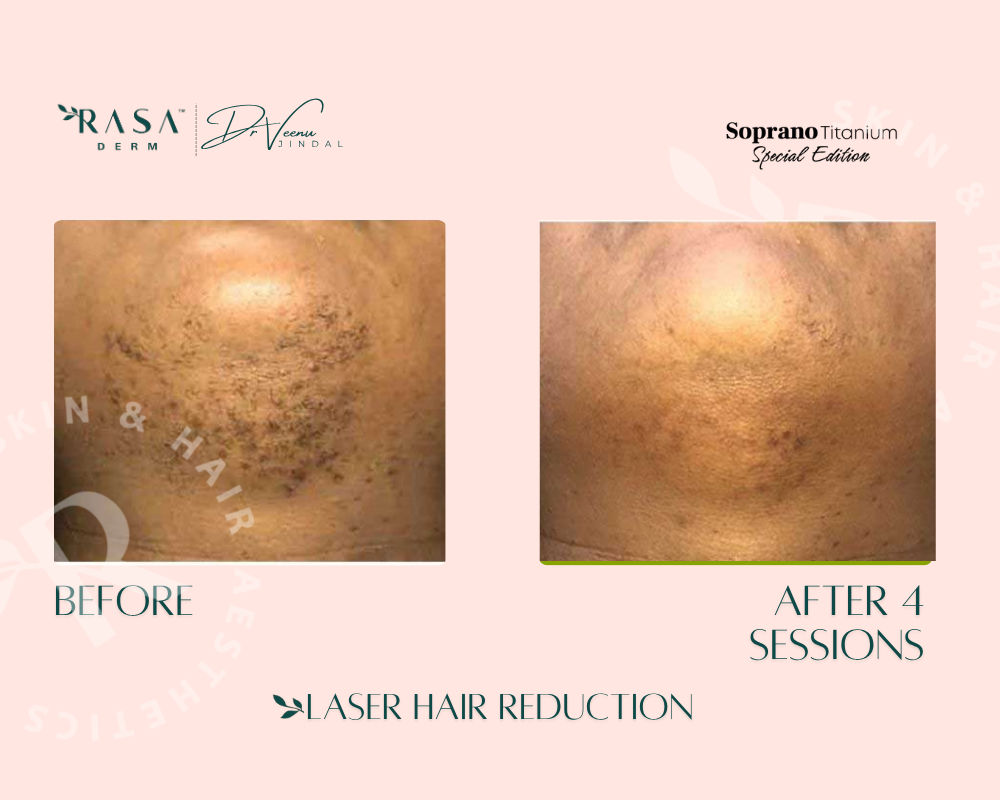
Seven Reasons Our Patients Stop Going Anywhere Else
Three Wavelengths. One Pass. Every Layer of the Follicle
Most machines pick one wavelength and hope for the best. The Alma Soprano Titanium Special Edition fires three — 755nm, 810nm, and 1064nm — at the same time, not one after the other. The 755nm catches what is sitting near the surface. The 810nm goes mid-follicle. The 1064nm hits the base — the part most machines never actually reach. Which is why patients who have done six sessions elsewhere and still have most of their hair see a completely different result here. The follicle is not partially treated. It is fully treated.
Indian Skin Was Never the Problem. The Machine Was
For years — honestly, too many years — patients with wheatish or deep brown skin were told laser was not safe for them, or that results would be limited. That was never about their skin. It was about the device. The 1064nm Nd:YAG wavelength in the Soprano Titanium Special Edition bypasses the melanin in your skin entirely. Goes straight to the follicle. At our Safdarjung and Ashok Vihar clinics, we treat Fitzpatrick IV, V, and VI at full therapeutic fluence. No dialled-down settings. No half-measures.
The Cooling Is Built In. Pain Was a Device Problem, Not a Treatment Problem.
Here is what actually happens at most clinics when a session hurts. The operator turns the laser down. They do not tell you this. The session feels like it is doing something. It is not — not enough, anyway. At RasaDerm, we use ICE Plus contact cooling. A sapphire tip running continuously across your skin through the entire session. Surface stays cool. Follicle gets the full dose. You feel warmth, not pain. We have had patients fall asleep during underarm sessions. That is not a coincidence. That is what proper cooling feels like.
Fastest Laser Available. Because Your Time Is Yours.
The Trio MAX applicator has a 4cm² spot size. Larger than almost every competing device on the market. Combined with SHR In-Motion technique — continuous movement rather than stationary pulses — it covers ground in a way that feels almost unreasonably fast. Full legs before lunch. Full back in one session. Sapio Research, an independent global agency, verified it in 2024 as the fastest laser hair removal system available. Both our Safdarjung clinic and our Ashok Vihar clinic have this machine. Not one of them. Both.
Safe Year-Round. Even in This City's Impossible Summers.
Older laser systems ask patients to avoid sun exposure for four to six weeks before each session. In Delhi. Where it is effectively summer nine months of the year. That was never a realistic ask and most people quietly ignored it anyway. The Soprano Titanium Special Edition uses SHR technology — gradual heating at high frequency, not a single aggressive pulse. Safe on moderately sun-exposed skin. We ask for two weeks without deliberate tanning before each session and daily SPF 50. That is a reasonable condition. Not a lifestyle overhaul.
Dr. Veenu Sets Your Protocol. Not a Printed Sheet.
Before the first session at either clinic, Dr. Veenu sits with you. Assesses your Fitzpatrick type, your hair pattern, whether there is a hormonal component, what you have tried before and what happened. This matters more than people realise. A woman with PCOS-related jaw hair and a woman treating her underarms are not the same case. Not even close. The fluence, the session spacing, the treatment mode — all set for you specifically. Tracked across every session. Adjusted as your hair responds. No two patients leave with the same protocol.
The Consultation Comes Before the Package. Every Time.
We do not sell packages at the front desk before anyone has looked at your skin. The first appointment is a conversation. Dr. Veenu tells you what is realistic — how many sessions, what percentage of reduction is genuinely achievable for your hair type and skin, whether anything about your medical history might affect results. If laser is not the right answer for what you are dealing with, she will say that directly. Patients come to us from Rohini, from Noida, from Gurgaon — often after spending money at three or four places — specifically because they wanted someone to be honest with them first.
More About Laser Hair Reduction at RasaDerm
From Dr. Veenu
The first thing I ask a new laser patient is not which area they want treated. It is where they have already been.
Because almost everyone has been somewhere. A salon in Saket that called their IPL machine a laser. A clinic running back-to-back walk-ins where nobody adjusted a single setting between patients. One woman came to our Safdarjung clinic last year — she had done nine sessions across three different places over two years. Nine sessions. Still had most of her hair on her chin and jaw. She was convinced her hair was resistant to laser. It was not. The machines were just never doing what she was told they were doing.
I am not saying this to make a point about other clinics. I am saying it because that pattern — patient blames herself, keeps trying, keeps spending — is something I see constantly. And it is fixable. Once you understand what the machine is actually doing and what yours was not, the path forward becomes obvious.
Laser hair reduction done correctly is one of the most effective treatments we have. Done with the wrong device, or the right device used at reduced settings because nobody bothered with proper cooling — it is an expensive way to slow your hair down temporarily.
The Alma Soprano Titanium Special Edition was not a purchase I made because it was new. I made it because after years of seeing what Delhi patients specifically need — darker skin tones, hormonal concerns, sun exposure that never really stops — this was the machine that addressed all of it without asking patients to compromise somewhere.
What Is Actually Happening Underneath Your Skin
Laser hair reduction works by sending light energy into the skin. The melanin in the hair follicle absorbs that light and converts it to heat. That heat damages the follicle structure enough that it cannot produce hair again. The surrounding skin stays unaffected — because the target is the follicle, not the surface.
Multiple sessions are not a commercial decision. They are a biological reality. Hair grows in three phases — anagen, which is active growth, catagen, which is transitional, and telogen, which is resting. Laser can only work on follicles in the anagen phase. That is when melanin is most concentrated and the follicle is most connected to the hair shaft. At any given time, not all your follicles are in anagen. Which means each session catches a different cohort. Six to eight sessions progressively eliminates the whole active population.
Now here is where the Soprano Titanium Special Edition does something different. Within each anagen follicle, the 3D simultaneous wavelength delivery targets multiple structures at once — the upper bulge, the mid-shaft, the base. A single-wavelength device hits one of those. Maybe two if you are lucky. We hit all three in the same pass. More complete destruction per follicle, per session. Fewer sessions to reach the same end result. That is not marketing language. That is the physics of why it outperforms standard diode lasers consistently.
Why So Many Delhi Patients Have Done This Before and Still Have Their Hair
Let us be specific. Three things go wrong most often.
The first is IPL. Most salons in Delhi use Intense Pulsed Light machines. Not lasers. IPL emits broad-spectrum light in a scattered, unfocused beam across multiple wavelengths. A laser emits one precise wavelength in a focused beam targeted at the follicle. The physics are fundamentally different. The outcomes are fundamentally different. IPL can slow hair growth. It cannot reliably destroy follicles, especially on coarse, dark hair. If you have sat through five or six sessions somewhere and your hair is mostly still there — there is a very good chance you were never treated with a laser at all.
The second problem is undertreated sessions. No active cooling means the operator has to lower the energy to keep the session tolerable. They lower it without telling you. The session feels like it is working. The fluence — the energy delivered per unit area — is below what actually destroys a follicle. Hair slows, comes back, patient returns, cycle repeats. ICE Plus cooling eliminates this entirely. Surface comfortable, follicle gets the full dose. Every single session.
The third is wavelength mismatch for darker skin. Standard 808nm diode lasers have a meaningful absorption overlap with epidermal melanin in deeper skin tones. To avoid burns, energy gets reduced again. Same problem, different reason. The 1064nm Nd:YAG was developed specifically because of this — minimal epidermal melanin absorption, maximum follicle targeting. At our Ashok Vihar and Safdarjung clinics, patients with deep brown skin get treated at full fluence. Safely. Because the wavelength was chosen for them, not adapted reluctantly.
PCOS and Hormonal Hair — A Different Conversation Entirely
A significant number of our patients — more than most clinics would tell you — are dealing with hormonally driven hair. Chin, jaw, upper lip, stomach, inner thighs. And this is not the same as treating underarms. Not even slightly.
Androgens stimulate follicles that would otherwise stay dormant. So even as laser eliminates active follicles session by session, the underlying hormonal environment can keep activating new ones. This does not mean laser does not work for PCOS-related hair. It absolutely does — we see it consistently at both clinics. What it means is the conversation going in needs to be honest about the timeline and about the fact that maintenance sessions, once or twice a year, are often part of the long-term picture.
(We have a patient who has been coming to our Ashok Vihar clinic every eighteen months for three years. Her chin hair — which used to be a daily problem — is now something she manages with one session a year. She considers that a success. It is.)
Dr. Veenu works with several gynaecologists and endocrinologists across Delhi. Where hormonal management is relevant to what is driving a patient’s hair growth, she facilitates that conversation. Laser plus hormonal treatment together delivers better and more durable results than either one alone. That coordination is part of what we offer.
Your First Appointment — What Actually Happens
Both clinics run the same protocol. Safdarjung, near AIIMS in South Delhi. Ashok Vihar in the north-west. Same machine. Same standard. Different side of the city.
You come in. Dr. Veenu assesses your skin type on the Fitzpatrick scale, your hair pattern, your hormonal history, any medications you are on, what you have tried before. She explains what the Soprano Titanium Special Edition does, why it is appropriate for your specific concern, and what results are realistic. You get a session count. A timeline. A rough idea of cost. You ask everything you want to ask.
Then — if you want to proceed — your first session is scheduled.
Nobody meets you at the door with a package to sign. Nobody closes a sale before anyone has looked at your skin. This sounds like it should be standard. In our experience, it is not.
What to Expect, Session by Session
Sessions one and two — hair shedding begins anywhere from one to three weeks after treatment. It looks like hair falling in the shower or when you wipe the area. That is the treated hair being pushed out by the follicle. It means the session worked. Regrowth starts slowing.
Sessions three and four — visible reduction. The skin stays smooth for noticeably longer between appointments. Hair that does come back is finer. Lighter. Easier to ignore.
Sessions five and six — for most body areas, this is where the permanent reduction phase begins. A significant portion of follicles are gone. Not slowed. Gone.
For hormonal areas we continue past session six, reassessing at each stage. The goal is not a number of sessions. It is the result.
Home care after each session: SPF daily, no active skincare acids for 48 hours post-treatment, no heat exposure the day of. These are not suggestions. A patient who skips sunscreen between sessions and comes back with a tan is setting herself back. We say this directly because most clinics hand over a printed sheet and never mention it again.
Treatment Areas
Upper lip · Chin · Sideburns · Full face · Underarms · Half arms · Full arms · Half legs · Full legs · Back · Chest · Stomach · Bikini line · Brazilian · Shoulders · Neck · Hands
Available at RasaDerm Safdarjung — South Delhi, near AIIMS Trauma Centre. Available at RasaDerm Ashok Vihar — North-West Delhi.
treatment procedure
Patient Journey – Bridal Dermatology Treatment
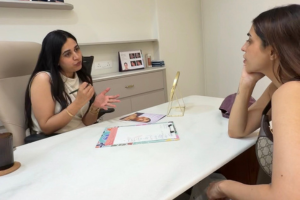
Consultation with our in-house dermatologist

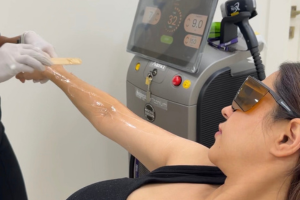
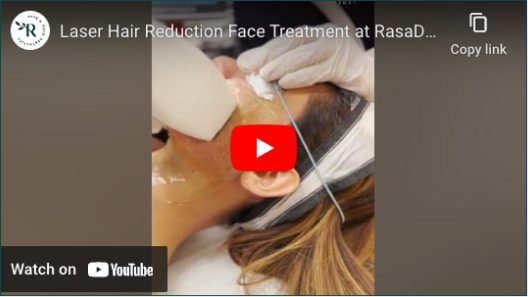
Area shaved, cooling gel applied. Skin prepped
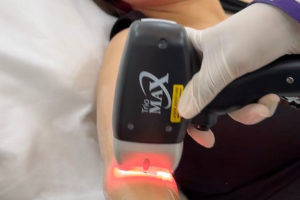
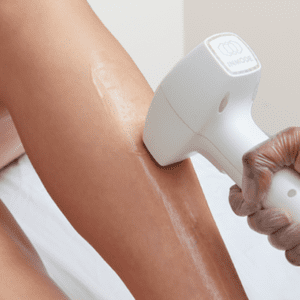
Painless laser pulses delivered with Alma Soprano Titanium.
FAQs for Bridal Dermatology
No — and this comes up so often it is worth addressing properly. That advice was about older machines. The 1064nm Nd:YAG wavelength in the Soprano Titanium Special Edition was developed specifically for Fitzpatrick IV through VI — which covers most Indian skin tones. It bypasses surface melanin entirely and targets the follicle directly. At both our Safdarjung and Ashok Vihar clinics, we treat patients with deep brown skin at full therapeutic fluence. Not reduced settings. Not with extra caution that quietly halves the effectiveness. The limitation was always the device, not the patient.
Depends on what you had done — but the answer is usually one of three things. The clinic used an IPL machine and called it laser. The energy was turned down mid-session because the device had no real cooling. Or the wavelength used was not appropriate for your skin tone so they reduced fluence to avoid surface damage. Any of those three means your follicles were irritated, not destroyed. Dr. Veenu will review what you had done and identify the specific gap before recommending anything. At both clinics, this review is part of the first consultation.
That unpleasantness was almost certainly a cooling problem. When a device has no effective surface cooling, operators lower the energy to make it tolerable. You get a session that hurts less but also does less. ICE Plus contact cooling on the Soprano Titanium Special Edition keeps the surface comfortable throughout, at full fluence. Warm. Not painful. We have patients who fall asleep during longer sessions — legs, back, full arms. It is a different experience to what most people have had before.
For body areas — underarms, arms, legs — six to eight sessions, four to six weeks apart. For hormonal facial areas — chin, jaw, upper lip — eight to ten, sometimes with annual maintenance after. The number Dr. Veenu gives you at consultation is based on your actual hair density, your skin type, and whether there is a hormonal component. It is not a number designed to sell you the largest package available. If four sessions would do it, she will say four.
Yes. The SHR technology in the Soprano Titanium Special Edition is safe on moderately sun-exposed skin. Two weeks without deliberate tanning before each session, SPF 50 daily — that is the ask. Older systems required four to six weeks of strict sun avoidance before every appointment. In Delhi, that meant most people either delayed treatment for months or came in inadequately protected and hoped for the best. We do not have that constraint here.
Indeed, our whole approach comprises lifestyle advice and dietary recommendations. We offer dietary advice that enhances skin health, hydration, and natural radiance, therefore complimenting your skincare treatments.
Salons use IPL. Almost universally. It is cheaper to buy, faster to operate, and much easier to train someone on. It is also not laser. IPL scatters broad-spectrum light across the skin. A medical-grade laser focuses one precise wavelength directly into the follicle. The physics are not comparable. The outcomes are not comparable. The Soprano Titanium Special Edition delivers three clinical wavelengths simultaneously under dermatologist supervision. You are not comparing two versions of the same thing. You are comparing two completely different technologies.
It works — but the framing needs to be right going in. PCOS-related hair responds well to laser. The chin and jaw hair that needs daily attention becomes genuinely manageable. What changes with PCOS is the long-term picture, because androgens can continue activating dormant follicles even after a full course of treatment. Most of our PCOS patients at both clinics see significant improvement. Some come back once a year for maintenance. That is not failure — that is managing an ongoing hormonal condition with the most effective tool available. Dr. Veenu will give you a realistic picture of what to expect for your specific pattern.
Whichever is closer, honestly. Both have the Alma Soprano Titanium Special Edition. Both run the same protocol under Dr. Veenu’s supervision. Safdarjung — A1/295, near AIIMS Trauma Centre, Nauroji Nagar — is easier if you are coming from South Delhi, Vasant Vihar, Green Park, Hauz Khas, Greater Kailash, Lajpat Nagar, or Saket. Ashok Vihar — B-2/7, Phase 2 — is better for Rohini, Pitampura, Punjabi Bagh, Shalimar Bagh, Karol Bagh, Paschim Vihar, Janakpuri. No reason to travel across the city for the same result.
Permanent reduction — yes. Permanent removal of every single follicle — that is not how the biology works, and any clinic promising otherwise is overstating the case. After a full course, most patients see 80 to 90 percent permanent reduction in density and coarseness. What remains, if anything, is finer and lighter. Most patients stop waxing and threading entirely. For patients with ongoing hormonal activity, annual maintenance keeps results stable. The goal is not zero hair forever. The goal is never having to manage it the way you do now.
Call +91-8014200700 or book at rasaderm.com. The first appointment is a consultation — no charge for the conversation. Dr. Veenu assesses your skin, gives you a session plan, and quotes you based on your specific areas and concern. Pricing varies by area and session count. We offer single sessions and packages, but the package conversation happens after the clinical one — not instead of it.

Two clinics.
One standard.
RasaDerm Safdarjung
South Delhi
A1/295, Upper Ground Floor, near AIIMS Trauma Centre,
Nauroji Nagar, Safdarjung Enclave, New Delhi – 110029
- Vasant Vihar
- Green Park
- Hauz Khas
- Greater Kailash
- Lajpat Nagar
- Saket
- Defence Colony
- Malviya Nagar
RasaDerm Ashok Vihar
North-West Delhi
B-2/7, Phase 2, Ashok Vihar,
New Delhi – 110052
- Rohini
- Pitampura
- Punjabi Bagh
- Shalimar Bagh
- Karol Bagh
- Paschim Vihar
- Janakpuri
- Rajouri Garden